
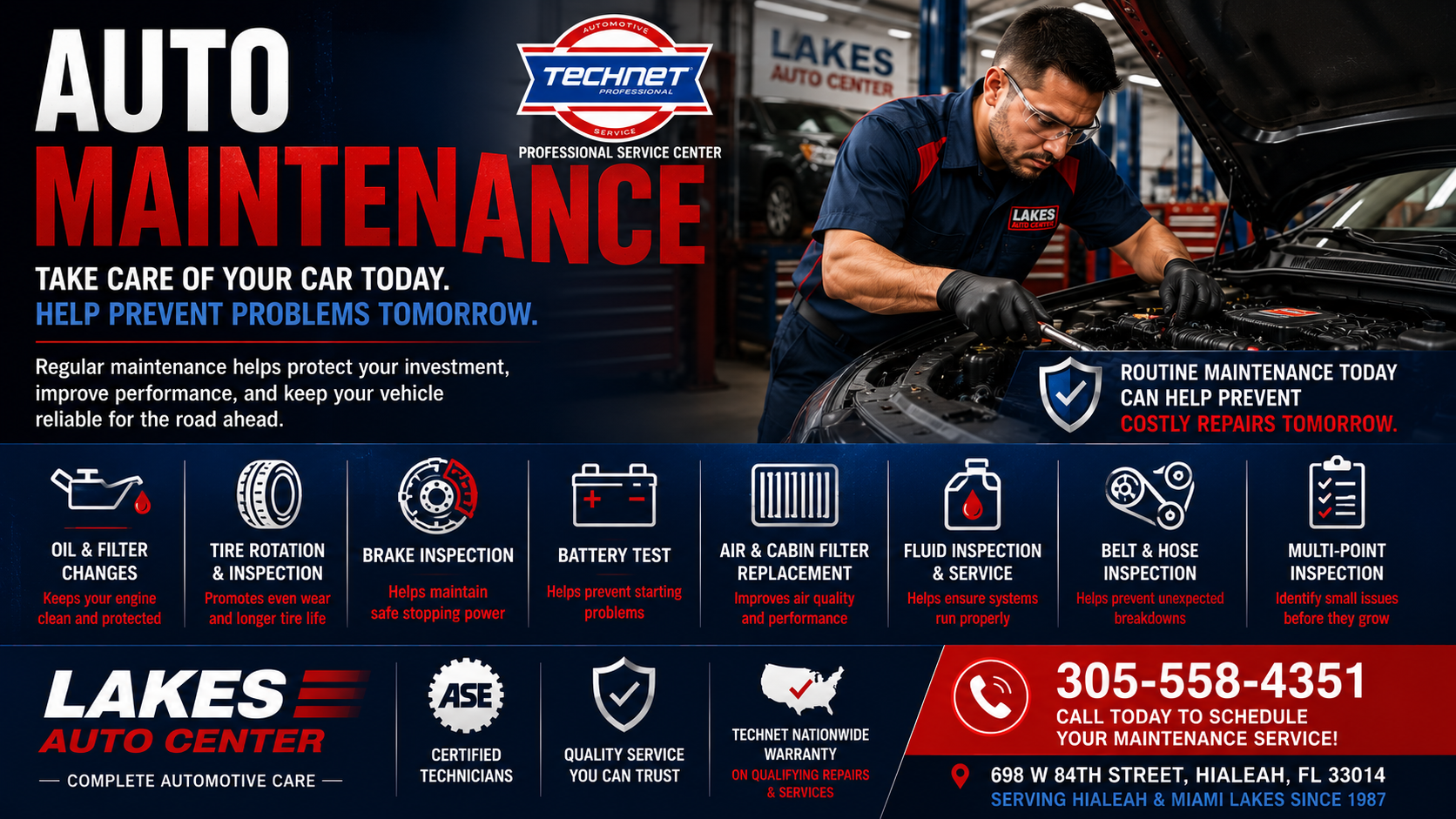
Auto Maintenance in Hialeah
Take Care of Your Car Today. Help Prevent Problems Tomorrow.
The easiest automotive problem to deal with is often the one that never becomes a breakdown.
Regular vehicle maintenance helps protect the systems you depend on every day—from the engine and transmission to the brakes, tires, cooling system, battery, filters, and fluids.
At Lakes Auto Center, we provide professional auto maintenance for drivers throughout Hialeah and Miami Lakes, helping you stay ahead of routine service and identify developing concerns before they become larger problems.
Opening Story
David’s car had been running perfectly.
No warning lights. No strange noises. No leaks in the driveway.
So when his dashboard reminded him that maintenance was due, his first thought was simple:
“The car is running fine. I’ll do it next month.”
Next month became three months.
Eventually, David stopped by Lakes Auto Center for an oil change. During the service, the technician noticed his battery was testing weak, one of his filters was overdue for replacement, and his front tires were beginning to wear unevenly.
None of those issues had stranded him.
None had triggered a Check Engine Light.
And none required an emergency repair.
David was able to address the maintenance on his schedule instead of waiting for the vehicle to choose the schedule for him.
That’s the value of preventive maintenance.
You don’t maintain a vehicle because something is broken. You maintain it to help keep things from breaking.
What Is Auto Maintenance?
Auto maintenance is the routine care your vehicle needs throughout its life.
Some maintenance is based on mileage.
Some is based on time.
Other services depend on the vehicle manufacturer, driving conditions, component condition, and previous maintenance history.
Depending on your vehicle, routine maintenance may include:
- Engine oil and filter changes
- Fluid inspections
- Fluid replacement
- Tire rotations
- Tire pressure checks
- Brake inspections
- Battery testing
- Engine air filter replacement
- Cabin air filter replacement
- Wiper blade replacement
- Belt and hose inspections
- Cooling system maintenance
- Transmission maintenance
- Wheel alignment inspections
- Spark plug replacement
- Manufacturer-recommended scheduled maintenance
- General vehicle inspections
The correct maintenance schedule should always be based on your specific vehicle and how it’s used.
Why Preventive Maintenance Matters
A vehicle contains thousands of components working together.
Many wear gradually.
Oil deteriorates.
Filters become contaminated.
Tires wear.
Brake pads become thinner.
Batteries weaken.
Fluids age.
Belts and hoses deteriorate.
Preventive maintenance gives technicians an opportunity to identify these changes before they potentially contribute to a breakdown or more expensive repair.
Regular maintenance may help:
- Improve vehicle reliability
- Protect engine life
- Maintain fuel efficiency
- Reduce unnecessary wear
- Maintain proper braking
- Extend tire life
- Protect transmission operation
- Reduce unexpected breakdowns
- Identify leaks early
- Maintain vehicle performance
- Protect your investment
Maintenance can’t guarantee that a component will never fail.
But it gives you a much better opportunity to stay ahead of normal wear.
Oil Changes: One of the Most Important Maintenance Services
Engine oil lubricates internal engine components while also helping manage heat and contamination.
As oil accumulates mileage and operating time, its protective properties can deteriorate.
Regular oil and filter changes using the correct oil specification help protect your engine.
Your appropriate oil-change interval depends on:
- Manufacturer recommendations
- Oil specification
- Engine design
- Mileage
- Driving conditions
- Vehicle usage
We don’t believe every vehicle should automatically follow the same oil-change interval.
Your vehicle’s requirements matter.
Fluids Keep Your Vehicle Working
Your automobile relies on several fluids to lubricate, cool, clean, protect, and operate different systems.
Depending on the vehicle, these may include:
Engine Oil
Protects and lubricates internal engine components.
Coolant
Helps control engine temperature and protect the cooling system.
Brake Fluid
Transfers hydraulic pressure through the braking system.
Transmission Fluid
Provides lubrication, cooling, and other functions depending on transmission design.
Power Steering Fluid
Used by certain hydraulic power-steering systems.
Differential & Gear Lubricants
Protect gears and related drivetrain components.
Windshield Washer Fluid
Helps maintain windshield visibility.
Fluid specifications and maintenance requirements vary significantly between vehicles.
Using the correct fluid is important.
Filters Protect Important Systems
Filters are designed to capture contaminants before they reach areas where they can cause problems.
Depending on your vehicle, maintenance may include:
Engine Air Filter
Helps prevent dirt and debris from entering the engine.
Cabin Air Filter
Helps filter air entering the passenger compartment through the heating and A/C system.
Oil Filter
Removes contaminants from circulating engine oil.
Other filters may also be used depending on vehicle design.
A filter should be replaced based on its condition and appropriate maintenance schedule—not simply because someone wants to sell you one.
Tire Maintenance
Your tires are your vehicle’s connection to the road.
Routine tire maintenance can help support:
- Traction
- Predictable handling
- Braking performance
- Tire longevity
- Fuel efficiency
- Ride quality
Tire maintenance may include:
- Tire pressure inspection
- Tread inspection
- Tire rotation
- Wheel balancing
- Alignment evaluation
- Inspection for irregular wear
- Tire replacement when necessary
Uneven tire wear can also provide clues about alignment, suspension, inflation, or other vehicle conditions.
Brake Inspections
Brake components wear gradually with use.
Regular inspections can help monitor the condition of:
- Brake pads
- Brake rotors
- Brake fluid
- Calipers
- Brake hoses
- Related components
Waiting until you hear grinding isn’t a maintenance strategy.
By that point, additional brake components may already be damaged.
Routine inspections provide an opportunity to address wear before braking performance becomes compromised.
Battery Maintenance Is Especially Important in South Florida
Florida heat can be hard on automotive batteries.
A battery may weaken gradually before one morning when the engine simply doesn’t start.
Battery and charging-system evaluation can help identify:
- Weak battery condition
- Charging concerns
- Terminal corrosion
- Connection problems
- Starting-system concerns
A battery that tests properly doesn’t need replacement simply because it has reached a particular age.
Again:
Test first. Replace when necessary.
Belts & Hoses
Belts and hoses live in one of the harshest environments in your vehicle.
They are exposed to:
- Engine heat
- Vibration
- Pressure
- Chemicals
- Age
- Thousands of operating cycles
Over time, they may develop:
- Cracks
- Fraying
- Swelling
- Soft spots
- Hardening
- Leaks
- Other deterioration
Inspection during routine maintenance can help identify developing concerns before a belt or hose fails unexpectedly.
Cooling System Maintenance
South Florida heat makes a properly functioning cooling system particularly important.
Your cooling system helps keep the engine within its designed operating temperature.
Maintenance and inspection may involve:
- Coolant condition
- Coolant level
- Radiator
- Hoses
- Water pump
- Thermostat
- Cooling fans
- Reservoir
- Related components
An overheating engine can suffer serious damage.
If your temperature gauge rises unusually or an overheating warning appears, don’t simply continue driving and hope it goes away.
Transmission Maintenance
Your transmission is one of the most complex and expensive systems in your vehicle.
Depending on vehicle design and manufacturer recommendations, transmission maintenance may include:
- Fluid inspection
- Fluid replacement
- Filter service when applicable
- Leak inspection
- Transmission operation evaluation
Modern automatic transmissions and CVTs may require very specific fluids and procedures.
Transmission maintenance should always be appropriate for the specific transmission in your vehicle.
Spark Plugs & Ignition Maintenance
Gasoline engines rely on the ignition system to ignite the air-fuel mixture inside the engine.
Spark plugs wear over time.
Depending on vehicle design, worn ignition components may contribute to:
- Rough running
- Misfires
- Poor acceleration
- Reduced fuel economy
- Hard starting
- Check Engine Lights
Spark plug replacement intervals vary significantly between manufacturers and engine designs.
Follow the appropriate schedule for your vehicle.
Scheduled Maintenance
Your vehicle manufacturer provides maintenance recommendations based on engineering requirements for that specific vehicle.
Scheduled maintenance may occur at particular:
- Mileage intervals
- Time intervals
- Operating conditions
Instead of relying on generic packages, we can help review the maintenance appropriate for your particular vehicle.
That can be especially helpful when you’ve purchased a used vehicle and aren’t sure what maintenance has already been performed.
South Florida Driving Can Affect Maintenance Needs
Driving in Hialeah and Miami Lakes presents its own challenges.
Our vehicles regularly experience:
- High temperatures
- Heavy traffic
- Stop-and-go driving
- Long periods of idling
- Frequent A/C operation
- Heavy rain
- High humidity
- Short trips
- Highway driving
Certain manufacturers classify some operating conditions as severe or demanding service.
Your maintenance recommendations should take how you actually use the vehicle into consideration.
What Happens When Maintenance Is Ignored?
Deferred maintenance doesn’t always cause an immediate failure.
That’s what makes postponing it tempting.
But eventually, neglected maintenance can contribute to:
- Increased component wear
- Reduced fuel economy
- Poor engine performance
- Transmission concerns
- Cooling-system problems
- Tire wear
- Brake problems
- Battery failure
- Unexpected breakdowns
- More expensive repairs
A $20, $50, or $100 maintenance item won’t necessarily prevent every expensive repair.
But maintaining the vehicle properly can help reduce avoidable problems and protect the systems you’ve already paid for.
Maintenance Is Different From Repair
This distinction is important.
Maintenance
Maintenance helps preserve systems that are currently operating.
Examples include oil changes, fluid services, filters, tire rotations, inspections, and scheduled service.
Repair
Repair addresses something that has already failed, worn beyond service limits, or stopped operating correctly.
Good vehicle ownership involves both.
But the more effectively maintenance is managed, the better opportunity you have to identify problems before repair becomes urgent.
Our Auto Maintenance Process
At Lakes Auto Center, we don’t believe maintenance should mean automatically selling every service available.
Our approach is straightforward.
1. Review
We consider your vehicle, mileage, maintenance history, and manufacturer recommendations.
2. Inspect
We evaluate appropriate maintenance items and visible vehicle conditions.
3. Identify
We determine what’s currently due, what may be developing, and what appears to be in acceptable condition.
4. Explain
We tell you what we found and why we’re recommending a particular service.
5. Prioritize
Not everything necessarily needs to be done today.
When appropriate, we help you understand what requires attention now and what can be planned for later.
6. Maintain
We perform the approved maintenance using the appropriate parts, fluids, and procedures.
7. Look Ahead
We help you understand what maintenance may be coming next.
No guessing. No one-size-fits-all schedule. Just appropriate maintenance for your vehicle.
Why Drivers Choose Lakes Auto Center
Since 1987, Lakes Auto Center has helped generations of drivers throughout Hialeah and Miami Lakes maintain their vehicles.
Our customers benefit from:
- ASE-Certified Technicians
- TechNet Professional Service Center
- Professional Diagnostic Equipment
- Vehicle-Specific Maintenance Recommendations
- Quality Parts & Fluids
- Complete Automotive Maintenance
- Complete Automotive Repair
- Honest, Clear Recommendations
- TechNet Nationwide Warranty on qualifying repairs and services
- Decades of Automotive Experience
We don’t want to see your vehicle only when something breaks.
We’d rather help you take care of it along the way.
Frequently Asked Questions
How often should I maintain my vehicle?
Maintenance intervals vary by manufacturer, vehicle, mileage, time, and operating conditions. Your owner’s manual and manufacturer recommendations are good starting points.
Do I need maintenance if my car is running fine?
Yes. Preventive maintenance is specifically intended to service and inspect components while the vehicle is operating normally.
How often should I change my oil?
Follow the appropriate manufacturer recommendation for your vehicle, engine, oil specification, and operating conditions.
Do you check other things during an oil change?
Depending on the service performed, additional visual inspections may identify maintenance concerns or developing problems.
How do I know what maintenance my used car needs?
Available service history, mileage, manufacturer recommendations, fluid condition, and vehicle inspection can help establish an appropriate maintenance plan.
Is preventive maintenance really cheaper than repairs?
Not every failure can be prevented through maintenance, but maintaining appropriate fluids, filters, wear components, and scheduled services can help prevent some avoidable damage and identify developing problems earlier.
Can you help me prioritize maintenance?
Yes. When multiple services or concerns are identified, we can explain which items deserve immediate attention and which may be planned for later.

Your Car Takes Care of You Every Day. Return the Favor.
Your vehicle gets you to work.
It takes your family where they need to go.
It sits in Hialeah traffic, handles South Florida heat, survives afternoon thunderstorms, and starts again the next morning.
Take care of it before it has to ask for help.
Bring your vehicle to Lakes Auto Center for professional preventive maintenance. We’ll help you understand what your vehicle needs today—and what you should be thinking about tomorrow.
Call 305-558-4351 today to schedule your auto maintenance service.
Lakes Auto Center
698 W 84th Street
Hialeah, FL 33014
Serving Hialeah & Miami Lakes Since 1987.
Disclaimer
The information on this page is for general educational purposes and should not replace vehicle-specific manufacturer recommendations or professional automotive diagnosis. Maintenance requirements vary by manufacturer, model, engine, transmission, mileage, operating conditions, and service history.
